
New Hardware is reader-supported: some links on this page are affiliate links, and as an Amazon Associate New Hardware earns from qualifying purchases at no extra cost to you. Learn more.
Tile saw rip capacity should usually be 24 in. to 30 in. for most first-time buyers. Choose 10 in. to 12 in. for small tile, and 36 in. or more only if you cut large-format tile or long planks in one pass.
Recommended rip capacity by use case
| use case | recommended rip capacity | why this number |
|---|---|---|
| Small bathroom wall tile | 10 in. to 12 in. | That range covers narrow cuts and keeps the saw size focused on light layout work. |
| Standard kitchen backsplash | 12 in. to 24 in. | Most backsplash layouts need repeatable cuts, not the longest possible rip. |
| General home renovation | 24 in. to 30 in. | This range handles many common floor and wall tile sizes without forcing a second pass. |
| Large-format floor tile | 36 in. to 48 in. | Longer tile needs more table travel so the full length can stay supported during the cut. |
| Plank tile and long diagonal cuts | 48 in. or more | Long, narrow pieces need extra rip room to stay aligned through the full cut. |
Tile Saws covered by our own reviews
3 options shown here, $104.99 to $1131.62, each with its own full review behind its name.
If you are a homeowner, you should view our comparison of wet tile saws for DIY projects.
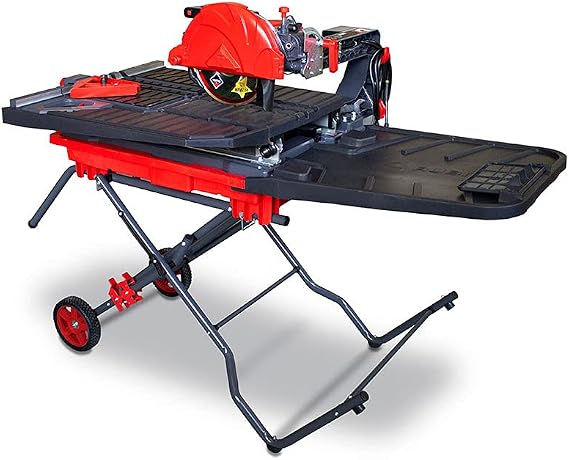
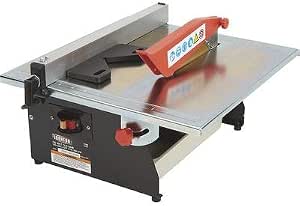
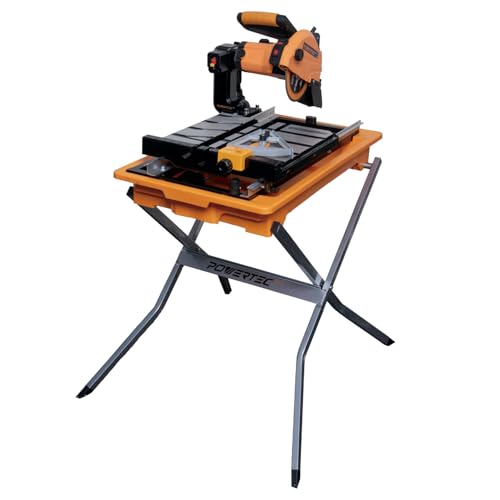
What happens if you go under or overbuy?
Too little rip capacity means the tile does not fit in one pass. That forces repositioning, which raises the chance of a crooked cut and slows every layout decision.
For those needing extra stability, see our guide to the best tile saw with stand.
Underbuying hurts most on large-format tile, where a partial cut can leave you with an unusable piece. A 24 in. rip capacity may be enough for many rooms, but it is not enough for every long tile shape.
Overbuying costs more than the job needs. A saw with 48 in. of rip capacity takes up more space, usually weighs more, and can be awkward if your work is mostly 12 in. tile or smaller.
To handle harder materials, look at our guide to the best tile saw for porcelain tile.
How extra rip capacity can go unused on smaller tile
The extra capacity also goes unused when your tile never needs it. If your largest piece is 18 in., a 36 in. saw gives you margin, but that margin does not improve the cut itself.
For smaller tasks, check out the best portable tile saw for small jobs.
What is the main rip capacity mistake?
The main rip capacity mistake is choosing for the longest tile in a store sample, not the longest tile in your project. Rip capacity should follow the largest piece you actually need to cut, plus a little margin for setup.
New users should see our breakdown of the best wet tile saw for beginners.
Why a 30-inch saw gives more room for tile adjustment
That margin matters because the tile rarely sits perfectly centered on the saw every time. If your longest piece is 22 in., a 24 in. saw leaves almost no room for adjustment, while 30 in. gives more freedom.
Many first-time buyers also confuse rip capacity with blade diameter or cut depth. Rip capacity measures how wide a piece can travel through the saw, not how thick the saw can cut or how large the blade is.
Understanding your budget is easier when you view what tile saws cost at every price level.
How to size rip capacity from the longest tile piece
If you are working from a room plan, measure the longest tile piece you expect to cut, not the room size. A 28 in. piece points you toward 30 in. or more, while a 14 in. piece keeps you in the 12 in. to 24 in. range.
Before buying, it helps to understand the different types of tile saws.
How rip capacity interacts with other tile saw limits
Rip capacity matters most when the saw can also support the tile size, cut depth, and bevel angle you need.
You can learn more about the mechanics by seeing how a tile saw works and what it is.
Maximum cut depth is the first limit to check after rip capacity. A saw with generous rip room still fails on thick stone or stacked material if its depth of cut is too shallow.
Blade diameter changes what the saw can physically cut through, but it does not replace rip capacity. A 7-inch blade may suit some smaller saws, yet long tile still needs enough table travel to stay stable.
For a deeper dive into specs, see our full review of the DEWALT D24000.
Bevel angle range matters when you need angled edges for corners or finished transitions. If your project needs a 45-degree bevel, a wide rip table does not help unless the saw can tilt to that angle.
You can view our spec breakdown of the RIDGID R4041S to see how it performs.
Wet saw workflow also changes the decision. Water-cooled cutting helps with dust and slurry, but it does not make a short rip table behave like a long one.
You can find more details in our full review of the Hoteche HT-P805107A.
For large-format tile, rip capacity and support length need to work together. If the tile hangs off the table too far, the saw may have enough nominal capacity but still be awkward to guide cleanly.