
New Hardware is reader-supported: some links on this page are affiliate links, and as an Amazon Associate New Hardware earns from qualifying purchases at no extra cost to you. Learn more.
A tile saw is a cutting tool that trims tile with a rotating blade and water control. You need one when straight cuts, corner cuts, or repeated sizing matter more than a score-and-snap tool can handle. Measure your tile thickness, cut length, and whether you need wet cutting before you choose one.
It solves the problem of clean cuts in hard, brittle material. Ceramic and porcelain chip easily at glazed edges, and a tile saw gives you a guided cut path instead of forcing the break line to do the work.
If you are working on a home renovation, see the best wet tile saw for DIY home projects.
How a tile saw cuts tile
A tile saw cuts by spinning a diamond blade through tile while water cools the blade and carries away dust. The cut happens in a controlled pass, not by cracking the tile along a scored line.
- The motor turns the blade at cutting speed.
- Water reaches the blade and the cut line.
- You feed the tile into the blade or move the head, depending on the saw style.
- The blade removes material in a narrow path.
- Slurry drops into the water tray, which holds water and slurry during cutting.
Wet saws and dry cutters change cleanup and indoor use
Wet saw vs dry cutter matters here. A wet saw uses water-cooled cutting, while a dry cutter follows a dustier workflow and leaves cleanup to the room and the user. If you are cutting indoors or near finished surfaces, that difference changes the whole job.
To handle harder materials, browse our comparison of the best tile saw for porcelain tile.
Tile Saws we have reviewed in detail
Prices across these 3 run from $132.99 to $1063.19; each one has a full review here.
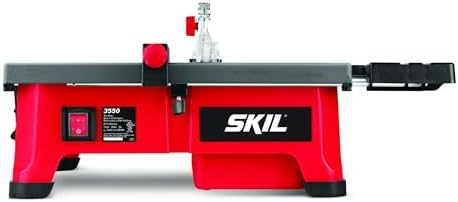


Tile saw parts that change the cut
Three parts shape the result most: the water tray, the rip fence, and the miter gauge. Each one changes either cut cleanliness, alignment, or angle control.
Professionals often prefer a smaller footprint, so view our guide to the best portable tile saw for small jobs.
Water tray holds slurry during cutting
The water tray holds water and slurry during cutting. Slurry is the mix of water and tile dust that comes off the blade, and the tray keeps it from spreading across the work area. A larger tray usually gives you more room for repeated cuts before cleanup.
For increased stability during heavy cutting, look at the best tile saw with stand.
Rip fence keeps straight cuts aligned
The rip fence keeps straight cuts aligned. It gives the tile a fixed guide so long rips stay consistent from one piece to the next. If your cuts drift, the fence is the first part to check.
Miter gauge guides angled cuts accurately
The miter gauge guides angled cuts accurately. It sets the angle for diagonal or corner work, which matters when a room ends at an outside corner or a border strip. A stable gauge saves time when you repeat the same angle many times.
Budget-conscious professionals can find options in our list of the best tile saw for contractors under $300.
Bridge saws and sliding-table saws change cut control
Bridge saw vs sliding-table saw also changes how the cut happens. A bridge saw keeps the head fixed over the tile, while a sliding-table saw moves the tile under the head. That choice affects how large a piece you can control and how much space the saw needs around it.
120V corded power keeps tile saws jobsite ready
120V corded power is the common jobsite standard. It ties the saw to an outlet, but it also avoids battery limits and keeps the tool in the same power class as many household circuits. If you need to move room to room, cord length and outlet access matter as much as the saw itself.
New users should start by viewing our guide to the best wet tile saw for beginners.
What a tile saw changes in practice
A tile saw changes the work most when you need repeated, accurate cuts in ceramic or porcelain. It matters on bathroom floors, shower walls, backsplashes, and trim pieces where a clean edge is visible.
Clarify technical specifications by viewing our guide to tile saw terms and specs.
It matters less when you only need a few rough cuts or when the tile is soft enough for a simple snap cutter. If your project has only straight, short cuts and no visible edge work, the saw may be more tool than you need.
The usual mistake is buying for blade size alone. A 10-inch blade can matter for deeper or larger cuts, but cut depth, fence quality, and water control decide whether the saw actually fits your job.
Learn about different designs in our breakdown of the types of tile saws.
Tile saw questions buyers ask
Will a tile saw cut ceramic and porcelain cleanly?
A tile saw will cut ceramic and porcelain cleanly when the blade, water flow, and feed rate match the tile. Porcelain is denser than standard ceramic, so a steady feed and a suitable blade matter more than raw speed. If the edge will stay visible, clean water management matters as much as the cut itself.
What do I give up with a cheaper tile saw?
With a cheaper tile saw, you usually give up table size, water control, and fence stability before you give up the basic cutting function. That can mean more chipping, more cleanup, or more time spent resetting cuts. If your tile is large-format, those tradeoffs show up fast.
For a deep dive into that specific model, see our full review of the HT-P805107A.
How does tile saw power and cut speed compare in this price range?
In this price range, higher motor power usually helps the blade keep moving through dense tile without slowing under load. Cut speed still depends on blade quality, water delivery, and how hard you push the tile. A faster saw is not always the cleaner saw.
You can see the technical details in our full review of the WEN 71745.
Is a bare tool tile saw worth it at this price?
A bare tool tile saw is worth it when you already own the right blade, stand, or water setup. If you have to buy those pieces separately, the lower entry price can disappear quickly. The real question is whether the package leaves you ready to cut on day one.
Is a tile saw worth it for a small bathroom or backsplash?
A tile saw is worth it for a small bathroom or backsplash when you need several clean cuts, corners, or outlet notches. It is harder to justify if the job is tiny and the cuts are simple. For one short run of tile, a rental or a simpler cutter may be enough.
Detailed performance data is available in our full review of the DT-10IN.
Who needs a tile saw and who does not
You need a tile saw if your project includes porcelain, repeated cuts, visible edges, or angled pieces. You also need one when water-cooled cutting is part of your dust control plan.
You do not need one if your work is limited to a few soft tiles, short straight cuts, or a one-time job where setup time outweighs the cut count. If your layout has no corners, no trim, and no large pieces, a simpler cutter may cover the task.
Get more details on that specific size in our full review of the 10-inch Wet Tile Saw.
If your jobsite has no easy outlet access, 120V corded power becomes a real constraint. In that case, you should weigh portability against the steadier power and longer run time that corded tools usually bring.