
New Hardware is reader-supported: some links on this page are affiliate links, and as an Amazon Associate New Hardware earns from qualifying purchases at no extra cost to you. Learn more.
Tile saw bevel angle range is the span of tilt settings, in deg, that lets the head or table make angled cuts. If you need corner joints or finished edges, the right range depends on the angles you actually plan to cut. First, decide whether your work calls for 45 deg or only straight cuts.
Which bevel angle range suits your work?
| if this is you | the bevel angle range that suits you | why |
|---|---|---|
| You only cut square edges and straight trim. | 0 deg or no stated bevel range | You do not need angled cuts, so a listed bevel range adds no practical value. |
| You cut occasional corner pieces for a backsplash or small room. | 45 deg | That single angle covers the common mitered edge cut used for corners and finished transitions. |
| You want one saw for general home tile work. | 0-45 deg | A range that includes 45 deg gives you the angled cut most tile jobs ask for. |
| You expect repeated angled cuts on different layouts. | More than one fixed angle, or a stated range wider than a single stop | Multiple stops give you more setup options when the layout changes from room to room. |
| You already know every cut will stay square. | No bevel function needed | You can spend on cut depth or table size instead of an angle setting you will not use. |
Products in this category with a full review here
From $104.99 to $1131.62: 3 of the 14 in this category we have reviewed in full.

How do you check your own bevel angle range before ordering?
Check your tile plans first, then match the bevel angle range to the cuts you will actually make. The number is usually written in the listing, the manual, or the saw’s adjustment markings, and six of the 20 listings we screened stated one figure: 45 deg.
Beginners can learn the fundamentals by reading our guide on how a tile saw works and what it is.
Use your layout drawings, not a guess. If your project includes outside corners, stair edges, or a finished border, mark every place where an angled cut appears and count how many of those cuts are truly 45 deg.
The angle gauge on the saw is the tool to use when the listing is vague. If the saw’s markings are clear, you can read the stop directly; if the markings are missing, the manual is the next place to check.
Returns policy matters here once. If you are unsure between two ranges, a seller with easy returns lowers the risk of choosing a setting you will not use.
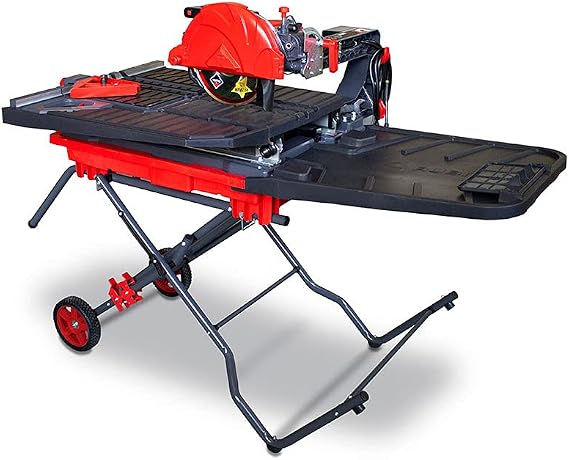
You can see how this specific power tool performs by viewing our full D24000S spec breakdown.
What goes wrong with the wrong bevel angle range?
A range that is too small blocks the cut you need. If your layout calls for 45 deg and the saw only offers a narrower tilt, the corner piece stays square and the joint will not meet cleanly.
A range that is wider than you need does not improve square work. It only adds adjustment you may never touch, and that can make setup slower when you are trying to repeat the same cut.
The mistake shows up in the cut line, not in the motor. You see an edge that cannot meet its mate, or you spend time resetting the tilt for no gain on straight cuts.
Check out our full WEN 71745 spec breakdown to see how this compact model performs.
Bevel angle range does not control cut depth. A saw with the wrong angle range can still make the right straight cut if the blade size and depth suit the tile.
What should you do when you fall between two bevel angle ranges?
Choose the range that includes the angle you will use most often. If your work is split between straight cuts and 45 deg corners, the safer choice is the range that states 45 deg clearly.
When two ranges both cover your work, favor the simpler setting. Fewer angle stops reduce the chance that you buy adjustment you will never use.
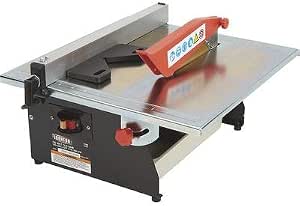
We provide a detailed analysis of the machine in our full Ironton 7in. Wet Tile Saw spec breakdown.
If your projects are uncertain, keep the decision tied to the hardest cut in the set. A saw that handles the most demanding angle you expect gives you room for the easier ones too.
If your only uncertain point is whether you will ever need angled cuts, leave them out of the decision. A straight-cut setup is enough for many tile jobs, and bevel range should not force a feature you do not plan to use.