
New Hardware is reader-supported: some links on this page are affiliate links, and as an Amazon Associate New Hardware earns from qualifying purchases at no extra cost to you. Learn more.
Miter saw terms matter most when they change cut width, angle control, or power source. Marketing words do not help much unless they map to a listed spec. Start with the blade diameter, bevel range, crosscut capacity, and motor power that match your stock and cut list.
New owners should start by viewing our guide to the best miter saw for beginners.
Miter saw capacity terms
Cut capacity terms tell you what the saw can reach in one pass. A larger number usually helps with wider trim and boards, while smaller numbers can still suit narrow stock and tighter spaces.
If you need a larger capacity, see our comparison of the best sliding miter saw.
- Blade diameter – This is the blade size, and 62 of 71 listings state one figure for it, from 7 to 22.5 inches.
- Crosscut capacity – This is the widest board the saw can cut straight across in one pass, and 26 of 71 listings state one figure for it. Bigger is better if you cut wide boards or baseboard in one pass; smaller numbers can mean you will need to flip or reposition the work.
- Bevel range – This is the tilt range for angled cuts, and 25 of 71 listings state one figure, from 45 to 90 degrees. A wider range gives you more angle options; if you need compound cuts, the useful number is the one that covers your planned tilt.
- Motor power – This is the amperage or current draw, and 43 of 71 listings state one figure, from 2.4 to 15A. A higher number usually matters more when you want sustained cutting strength, while a lower one can suit lighter trim work.
- Cutting width – This term often means the same thing as crosscut capacity on listings, so check the exact wording before you compare saws. Bigger is better for wide lumber, but the term is only useful when the listing states an actual number.
Where these choices show up in our reviews
Each of the 3 shown here has its own full review on this site; they run from $369 to $1099.
For decorative work, see which saw is the best miter saw for crown molding.

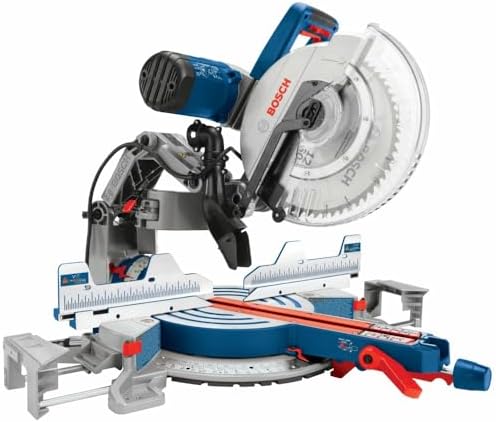

Angle and tilt terms for trim joints and compound cuts
Angle terms control how the saw sets up for trim joints and compound cuts. If you work on crown, casing, or picture-frame angles, the setting that matters is the one you can repeat without guessing.
Space-conscious owners can see the best miter saw for small workshop setups.
If you need portability, check out our comparison of the best cordless miter saw.
- Miter scale – This shows the angle setting for repeatable cuts, and it is the dial or marked scale you read before swinging the saw head. A clearer or finer scale helps more than a larger number; what matters is whether your target angle is easy to set accurately.
- Bevel scale – This shows the tilt setting for compound cuts, and it tells you how far the saw head leans. A wider usable range helps if you cut compound joints, while a narrow scale can still be enough for simple angled trim.
- Single bevel – The head tilts one way only, so compound cuts require flipping the work. That limitation matters most if you repeat left- and right-leaning cuts; a double bevel saves that extra step.
- Double bevel – The head tilts both left and right, which speeds repeated angled cuts. This is the better choice if you make many compound cuts, because you do not have to turn the work as often.
- Compound miter cut – This is a cut that uses both miter and bevel settings at once. Better control comes from a saw with clear angle scales and enough bevel range for the joint you need.
Saw design and setup terms
Saw design terms describe the frame, movement, and support parts that shape how the saw works on the bench. Some of these terms affect cut capacity directly, while others affect how easy the saw is to line up and use.
For advanced versatility, look at our analysis of the best compound miter saw.
- Sliding compound miter saw – The rail system is the format that determines crosscut capacity, so a sliding design usually gives more reach than a fixed-head saw. Bigger is better here if you need to cut wide stock, because the slide is what extends the cut.
- Fence – The fence supports and squares the workpiece for accurate cuts. A taller or steadier fence helps when you cut trim and boards that need to stay flat against the back support.
- Blade guard – This covers the blade for safer operation, and it moves out of the way as the cut starts. The guard is not a performance spec, so the useful question is whether it fully covers the blade when the saw is at rest.
- Work clamp – This holds the stock in place while you cut, and 21 of 71 listings state it. A clamp matters more when you cut short pieces or repeat the same angle, because movement can spoil the cut line.
- Laser guide – This projects a line for alignment, and 24 of 71 listings state it while 7 state that it is absent. A guide can help with setup, but it is not a substitute for a clear fence and a correct angle setting.
Power source and fit terms
Power source and fit terms tell you what the saw needs to run and what extra parts it accepts. The right choice depends on whether you want corded runtime, cordless portability, or a blade and dust setup that matches the tool.
Understanding the basics is easy with the different types of miter saws explained.
- Corded 15-amp – This means the saw plugs in and draws 15 amps, so sustained power is the point. Bigger is better only if your outlet and circuit can support it; otherwise, the portability of a cordless saw may matter more.
- Cordless 20V MAX ecosystem – This means the saw runs on a battery platform, so portability is the point. If you move around a site or have no easy outlet, this choice changes the whole setup more than a small spec difference does.
- Miter saw blade – This determines cut type and finish quality, and it must match the saw’s blade diameter and arbor fit. A finer tooth count usually helps finish quality, while a larger diameter only works if the saw accepts it.
- Dust bag – This collects some sawdust at the source, and it only works if the bag or port fits the saw’s dust outlet. Bigger capacity helps you empty it less often, but no bag turns a saw into a dust-free tool.
- Blade wrench – This is the tool used to change the blade, and 11 of 71 listings state it. If the saw includes one, it should fit the arbor nut; if it does not, you need the correct wrench size before blade changes are practical.
Miter saw terms buyers often confuse
Miter saw listings use similar words for different jobs, and that is where many comparisons go wrong. The difference usually comes down to whether the term names angle control, cut reach, or a support part.
If a saw isn’t right for you, explore the miter saw alternatives to get similar results.
Why miter scale is not the same as bevel scale
The miter scale shows the angle setting for horizontal rotation, while the bevel scale shows the tilt setting. If you need a compound cut, you need both numbers, not just one of them.
Ensure your equipment is safe by viewing the miter saw certifications and safety standards.
To manage your budget, see what miter saws cost and the value of each price level.
Why blade diameter is not the same as crosscut capacity
Blade diameter names the blade size, but crosscut capacity names the widest board the saw can cut in one pass. A larger blade does not automatically mean a wider cut, so read the cut-width figure separately.
You can find a detailed breakdown in our full review of the C10FCH2.
Why single bevel is not the same as double bevel
Single bevel means the head tilts one way only, and double bevel means it tilts both left and right. The second option saves flipping the work when you repeat angled cuts, which matters more on trim jobs with many mirrored joints.
Technical specs are available in our full review of the LS1018.
Why a fence is not the same as a blade guard
The fence supports and squares the workpiece, while the blade guard covers the blade. One helps accuracy, and the other helps safe operation, so they solve different problems.
For more details on that model, see our full review of the DWS715.