New Hardware is reader-supported: some links on this page are affiliate links, and as an Amazon Associate New Hardware earns from qualifying purchases at no extra cost to you. Learn more.
Compact band saw tool length should usually land between 15 in. and 18 in. for most buyers. If you need the saw between studs, stay at 15 in. or less; if you need it to share a tool bag with other hand tools, stay at 18 in. or less. Measure the narrowest space you need to reach, then compare that space with the saw’s overall length.
Compact Band Saw Tool Length by Use Case
| use case | recommended tool length | why this number |
|---|---|---|
| work between studs without the saw feeling bulky | no more than 15 in. | That threshold keeps the body short enough for tighter framing gaps. |
| fit in a tool bag with other hand tools | no more than 18 in. | That limit comes from the bag space a compact saw must share with pliers, drivers, and blades. |
| carry the saw on a ladder or lift | 12 in. to 16 in. | Shorter bodies are easier to move one-handed when the tool rides with you instead of on a cart. |
| store the saw on a crowded truck shelf | 14 in. to 18 in. | That range keeps the saw short enough to fit beside chargers, batteries, and cases. |
| reach into a tight mechanical room | 15 in. or less | Any longer body starts to compete with elbows, pipe, and nearby framing. |
Where these choices show up in our reviews
Prices across these 3 run from $149 to $434; each one has a full review here.


What Happens If You Go Too Short or Too Long?
Too short can cost you reach. A saw under 12 in. may fit cramped spaces well, but it can force awkward positioning when the cut sits behind obstructions or near a wall. If your work shifts between open runs and tight bays, that short body becomes a constant compromise.
If you are new to these tools, you can learn how a compact band saw works to understand the mechanics behind the cutting action.
Compact band saws over 18 in. waste space and control
Too long costs space and control. A saw past 18 in. is harder to slip into a bag, more awkward around studs, and more likely to feel oversized for routine service work. Overbuying is real here, because extra length gives you no cutting advantage by itself.
The Tool Length Mistake Most Buyers Make
The mistake is choosing length before checking the space the saw must enter. Tool length only tells you how much room the body takes up; it does not tell you how much material the saw can cut. If your work is mostly between studs, the number to protect is 15 in., not a longer body that looks more capable.
For a deeper look at the sub-compact features, see our full M12 Band Saw review to see how it performs in tight spots.
Choose compact band saw length for the tightest access point
What should you optimize instead? Optimize for the tightest access point you face most often, then treat anything longer as a storage penalty. If you carry the saw in a bag with other hand tools, 18 in. is the practical ceiling. If you work in framing cavities, the ceiling drops to 15 in.
One question matters here: where does the saw need to fit most often? If the answer is between studs, keep it at 15 in. or less. If the answer is a tool bag, keep it at 18 in. or less.
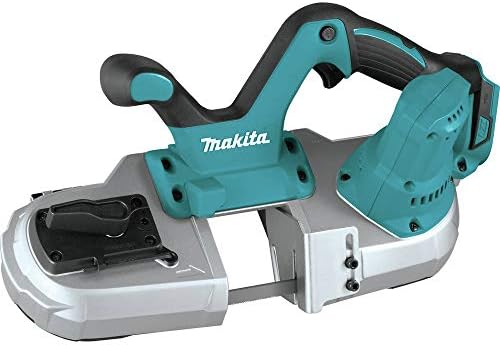
Detailed specifications on the Makita model are available in our full XBP03Z spec breakdown to help you decide if it fits your needs.
How Tool Length Interacts With Other Limits
Tool length is only one deciding spec. A longer saw does not fix a low cutting capacity, and it does not change battery voltage. If the cut you need is larger than the saw can pass through, extra body length will not solve that limit.
Compact band saw cutting capacity reaches 2-1/2 in
The category reference point for cutting capacity is 2-1/2 in. That figure marks the largest stock size a saw can actually pass through, and it sits apart from tool length. A compact saw with the right length can still fail you if the cut depth is too small for your pipe, conduit, or strut.
You can find a detailed analysis of the M18 FUEL model in our full 2829-20 spec breakdown to see its power capabilities.
Battery platform matters too. The 18 V platform is the point where cordless metal-cutting work usually becomes practical, while 24 V often brings more runtime and torque than 12 V compact saws.
Weight can cancel the advantage of a short compact band saw
Weight can erase the benefit of a short body. A compact saw that is short but heavy still feels awkward overhead or on a ladder. If you carry the tool for long stretches, length and weight need to work together, and neither one can compensate for the other.
For a deeper look at the RIDGID model, see our full R8604B spec breakdown to see how it compares to other compact options.
Blade format limits compact band saw size and tooth options
Blade format is another hard limit. The common 1/2 in. x 0.020 in. band saw blade format governs blade size and tooth options, not body length. A saw can be short enough for tight spaces and still be a poor fit if the blade format does not suit the material you cut most often.