New Hardware is reader-supported: some links on this page are affiliate links, and as an Amazon Associate New Hardware earns from qualifying purchases at no extra cost to you. Learn more.
A compact band saw is a handheld saw that cuts metal with a continuous blade. You need one when a pipe, conduit, or strut has to be cut where a larger saw will not fit. First decide the largest stock size you need to pass through, then match the saw’s cutting capacity to that size.
Its job is simple: make a straight cut in cramped spaces without forcing you to swing a larger tool around the work. That matters most when access is tight, overhead, or between studs, because the saw’s size and battery choice shape what you can reach and how long you can keep working.
How a Compact Band Saw Cuts
A compact band saw cuts by moving a narrow blade in one continuous loop around two wheels. The blade teeth travel in one direction, so the saw removes material as the workpiece is fed into the moving teeth.
- The trigger switch starts the motor. It also stops the saw during use, so control begins at the handle.
- The motor turns the wheels, and the blade moves around them at cutting speed.
- The shoe supports the workpiece and stabilizes the saw, so the cut stays steadier as pressure changes.
- You guide the saw by the handle. That grip point matters when the cut starts in a tight spot.
Blade size and tooth options shape cutting performance
The 1/2 in. x 0.020 in. band saw blade format changes what the saw can do. Blade size and tooth options govern cut speed and material range, so the wrong blade can slow the cut or limit the stock it handles well.
Compact Band Saws we have reviewed in detail
Prices across these 3 run from $149 to $434; each one has a full review here.
For a deeper look at the M12, see our full M12 Band Saw review for a detailed spec breakdown.
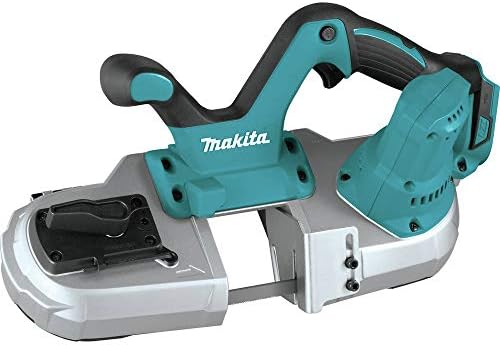


Compact Band Saw Parts That Change the Result
The blade guard, shoe, trigger switch, and handle are the parts that change the result most. Each one affects either control, support, or how confidently you can start and finish the cut.
That matters when you want the blade to track cleanly through metal instead of wandering at the start.
The shoe supports the workpiece and stabilizes the saw. A steadier shoe helps when the material is short, round, or awkwardly placed.
The trigger switch starts and stops the saw during use. A predictable trigger matters more than extra features when you are making repeated cuts in a day.
The handle provides the grip and control point. If you need one-handed control, the handle shape matters more than the rest of the body design.
A closer look at the M18 FUEL model is available in our full 2829-20 spec breakdown.
A 12 V setup usually favors lighter tool families, while 18 V and 24 V systems open more cordless options for routine metal-cutting work.
Bare tool vs kit changes the first purchase. Bare tool pricing suits you if you already own the right battery and charger, while a kit bundles the battery-plus-charger package for a new start.
What a Compact Band Saw Changes in Practice
A compact band saw changes access first. It helps when the cut has to happen in a place where a larger saw body, longer shoe, or bulkier battery pack would get in the way.
It does not replace every cutting tool. If your work is mostly open bench cuts, a larger saw or a different cutter may be easier to keep square and may move faster through repeated stock.
Portability is the main gain, but it comes with tradeoffs.
Detailed technical data is available in our full R8604B review for those considering the Ridgid model.
If your work shifts between overhead cuts and floor-level cuts, the weight matters as much as the voltage. A lighter saw is easier to position, while a higher-voltage platform often means more battery investment and a larger pack.
Compact Band Saw Buyer Questions
How does a compact band saw compare on portability to other compact band saws?
Portability on a compact band saw comes down to tool length, tool weight, and battery format. A shorter and lighter saw is easier to move between studs, overhead, and tight mechanical spaces.
How does a compact band saw compare on cut speed and ease of use?
Cut speed and ease of use on a compact band saw depend on the blade format, the shoe, and the handle. The 1/2 in. x 0.020 in. band saw blade format gives you blade size and tooth options that affect how quickly the saw bites into metal.
A steadier shoe and a clear trigger switch make the saw easier to control. If the saw feels awkward to position, the cut usually slows before the blade does.
How fast does a compact band saw cut in this price range?
Cut speed in this price range varies more by blade choice and battery platform than by price alone. A better blade match can matter more than a higher sticker price when you are cutting common pipe or conduit.
You can find a complete analysis of the FLEX FX2331-Z performance data on our dedicated page.
Budget-first shoppers should look at the battery ecosystem before chasing speed claims. A kit may cost more up front, but it also changes what you can run on day one.
Who Needs a Compact Band Saw
You need a compact band saw if your cuts happen in tight spaces, on installed material, or in places where a larger saw cannot move freely. That is the right condition for one-handed control and short-body access.
You do not need one if your work is mostly open, repetitive, and easy to clamp. In that case, cutting capacity and blade choice may matter more than portability, and a different saw can be the better fit for the job.
If you already own the right battery family, bare tool pricing can keep the first purchase lower. If you do not, the kit route makes more sense because the battery and charger are part of the real cost of entry.