
New Hardware is reader-supported: some links on this page are affiliate links, and as an Amazon Associate New Hardware earns from qualifying purchases at no extra cost to you. Learn more.
Chainsaws usually land in the two middle price bands, from $139.99 to $237.05, and price rises most visibly in battery voltage and capacity. These prices were checked in November 2026, and retail prices move; if you are choosing one, compare your cutting time and power needs against those medians first.
Chainsaw Price Levels at a Glance
| Price level | Price range | Products | Median battery voltage | Median battery capacity | Median rating |
|---|---|---|---|---|---|
| Entry level | $104.49 to $138.99 | 23 | 40V | 2.3Ah | 4.2 |
| Lower mid-range | $139.99 to $168.89 | 24 | 40V | 4Ah | 4.2 |
| Upper mid-range | $169.75 to $237.05 | 24 | 32V | 4Ah | 4.3 |
| Top end | $239 to $649 | 24 | 48V | 4Ah | 4.4 |
Products in this category with a full review here
From $145 to $328.38: 3 of the 15 in this category we have reviewed in full.
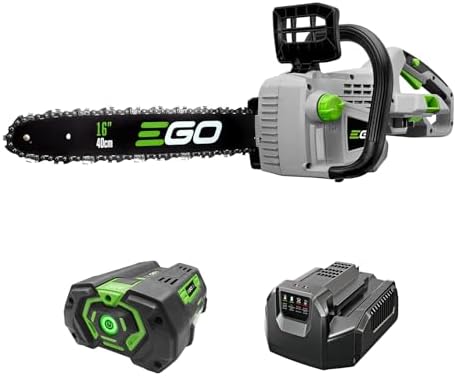


What entry-level chainsaws get you
Entry-level chainsaws run from $104.49 to $138.99, with a median price of $119.99. In this band, the median battery voltage is 40V, the median battery capacity is 2.3Ah, and the median buyer rating is 4.2.
This level suits light pruning, small storm cleanup, and short jobs where a lower upfront cost matters more than runtime. A 40V platform can cover that brief use pattern, but the 2.3Ah median points to shorter sessions and more time spent swapping or recharging.
Selecting the correct bar length is vital for your specific job, so see our guide on choosing the right bar length.
If your work is a few branches after a storm, entry level is the price band that keeps the purchase simple. If you expect longer cuts, or several piles of debris, the next band gives more stored charge without a large jump in price.
What lower mid-range chainsaws add
Lower mid-range chainsaws sit from $139.99 to $168.89, and the median price is $153.99. Their median battery voltage is still 40V, but the median capacity rises to 4Ah, and the median buyer rating stays at 4.2.
That extra capacity matters more than the voltage number here. A 4Ah battery stores more charge than 2.3Ah, so this band better fits longer pruning sessions, repeated cuts, and jobs where you want fewer interruptions.
To ensure your chain fits your bar perfectly, learn about selecting the correct chain gauge.
This is the sensible middle for a first-time buyer who wants to stay near the lower end of the market but avoid the shortest runtimes. The trade-off against the next band is not a huge change in price alone; it is the shift to a different voltage pattern and a higher median price per unit of battery voltage, which signals less value per volt on paper.
What upper mid-range chainsaws change
Upper mid-range chainsaws run from $169.75 to $237.05, with a median price of $191.03. Their median battery voltage is 32V, the median capacity is 4Ah, and the median buyer rating is 4.3.
This band is where the price rises without a matching rise in the voltage median. The 4Ah capacity keeps runtime in the same general zone as the lower mid-range, but the 32V median shows a different motor class than the 40V figures in the cheaper bands.
Understanding the differences between gas, electric, and battery models is easy in our guide to different chainsaw types.
That makes this level a fit when you care more about the overall package than about chasing the lowest cost per volt. A buyer who wants a longer bar, stronger cutting reserve, or a broader spread of features may land here, but the next band is where the higher-voltage options become more common.
What top-end chainsaws add
Top-end chainsaws range from $239 to $649, and the median price is $379.50. Their median battery voltage is 48V, the median battery capacity is 4Ah, and the median buyer rating is 4.4.
This band suits you when voltage matters more than initial cost and you want the highest median electrical supply in the set. A 48V median points to the strongest battery class in these price groups, while the 4Ah median shows that runtime does not automatically rise with price in the same way voltage does.
The gain over the upper mid-range is mostly in electrical headroom, not in a bigger storage figure. If your work is frequent or demanding, this is where the category starts asking you to pay for that extra headroom.
For a deeper look at the 40V model, see our full review of the LCS1240B for detailed specs.
Where paying more stops buying more
Paying more stops buying more runtime once capacity holds at 4Ah. That figure appears in the lower mid-range, upper mid-range, and top end, even as the median price moves from $153.99 to $379.50.
The price-per-unit figures show the same pattern from another angle. The median cost per unit of battery voltage is $3.34 in entry level, $3.98 in lower mid-range, $6.66 in upper mid-range, and $7.27 at the top end.
That means the value curve flattens for capacity and keeps rising for voltage. If you only need longer runtime, the lower mid-range gives the cleanest step up; if you want more electrical headroom, the top end is where the higher voltage median becomes the main reason to spend more.
You can find a detailed spec breakdown by viewing our full review of the 40417 cordless model.
What to budget for beyond the saw
Beyond the saw itself, budget for replacement chain, bar and chain oil, a spare battery, and a battery charger. A replacement chain has to match the chain pitch and bar gauge, which are the fit dimensions that keep the chain and bar working together.
Bar and chain oil is a running cost, not a one-time add-on. The saw needs the right oil supply during use, and the buyer should expect to keep buying it as the chain cuts.
A spare battery matters when job length exceeds one pack, and it has to match the same battery system as the saw. A battery charger also has to match that battery system, or the pack will not recharge for continued use.
To see how this 16-inch model performs, check out our full review of the PR4016 for more data.
If you are choosing between a cheaper saw and a larger battery budget, count the second battery before you count the first upgrade. A tool-only purchase without a compatible battery system leaves the saw unusable until the right battery and charger are added.
Confirm the current rules for your location before ordering, because local restrictions can affect the purchase decision.
How to tell a fair chainsaw price
A fair chainsaw price is the one that matches the deciding specification, not the sticker alone. For this category, that usually means battery voltage or battery capacity, because those are the figures that change most clearly with price.
Get a detailed spec analysis by reading our full review of the CS1604 power system.
Use the medians as your anchor. Around $119.99 usually buys a 40V, 2.3Ah entry-level saw, around $153.99 usually buys a 40V, 4Ah lower mid-range saw, around $191.03 usually buys a 32V, 4Ah upper mid-range saw, and around $379.50 usually buys a 48V, 4Ah top-end saw.
If you want the simplest value check, divide the price by the voltage figure and compare the result to the band medians. The lower mid-range has the lowest median price per unit of battery voltage at $3.98, while the top end sits at $7.27, so higher price does not always mean better value for voltage.
That makes the fair-price question straightforward: pay for the voltage or runtime you will actually use, and do not pay extra for capacity once 4Ah is already enough for your jobs. If your work is light, the entry and lower mid-range bands usually make the most sense; if your work is frequent or long, the top end is where the higher voltage median justifies the jump.